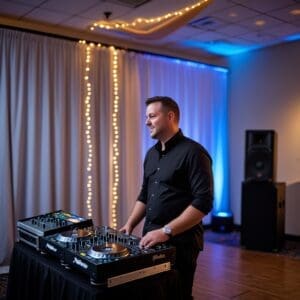
A corporate event DJ is a trained entertainment professional who manages music, sound equipment, and live hosting duties to keep a company function running smoothly from start to finish. Beyond playing songs, this person reads the room, adjusts volume for speeches, cues award presentations, and often serves as the event’s master of ceremonies. According to the American Disc Jockey Association (ADJA), corporate bookings now make up roughly 28 percent of professional DJ revenue nationwide in 2026, reflecting how many companies have shifted away from in-house playlists toward hired talent. That shift matters because entertainment quality shapes how employees remember an event long after the catering is forgotten.
Whether you are organizing a holiday party in Raleigh, a product launch in Chicago, or an awards gala in New York, the fundamentals of hiring the right person do not change much. What changes is scale, budget, and the specific mix of services you need layered on top of the music.
Key Takeaways
- A corporate event DJ combines sound engineering, MC hosting, and live crowd reading, not just song selection.
- Typical costs range from $600 for a small three-hour reception to $6,000 or more for a large gala with lighting, staging, and multiple MC segments.
- Per Bizzabo’s 2026 State of Events report, 73 percent of event planners say entertainment quality directly affects attendee satisfaction scores.
- Liability insurance and a written contract are non-negotiable; many corporate venues will not allow a vendor onsite without proof of coverage.
- Add-on services such as photo booths and intelligent lighting can turn a standard holiday party into shareable, branded content.
What a Corporate Event DJ Actually Handles
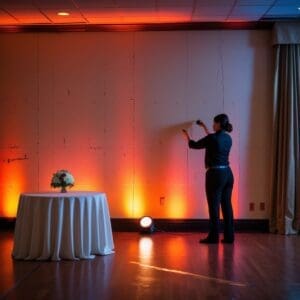
The job splits into three overlapping responsibilities: sound engineering, event pacing, and hosting. On the technical side, the DJ sets up speakers, subwoofers, and wireless microphones calibrated to the specific room, whether that is a hotel ballroom, an outdoor tent, or a converted warehouse space. A poorly tuned amp or a single point of audio failure can derail a keynote address in seconds, so experienced DJs travel with backup gear for exactly that reason.
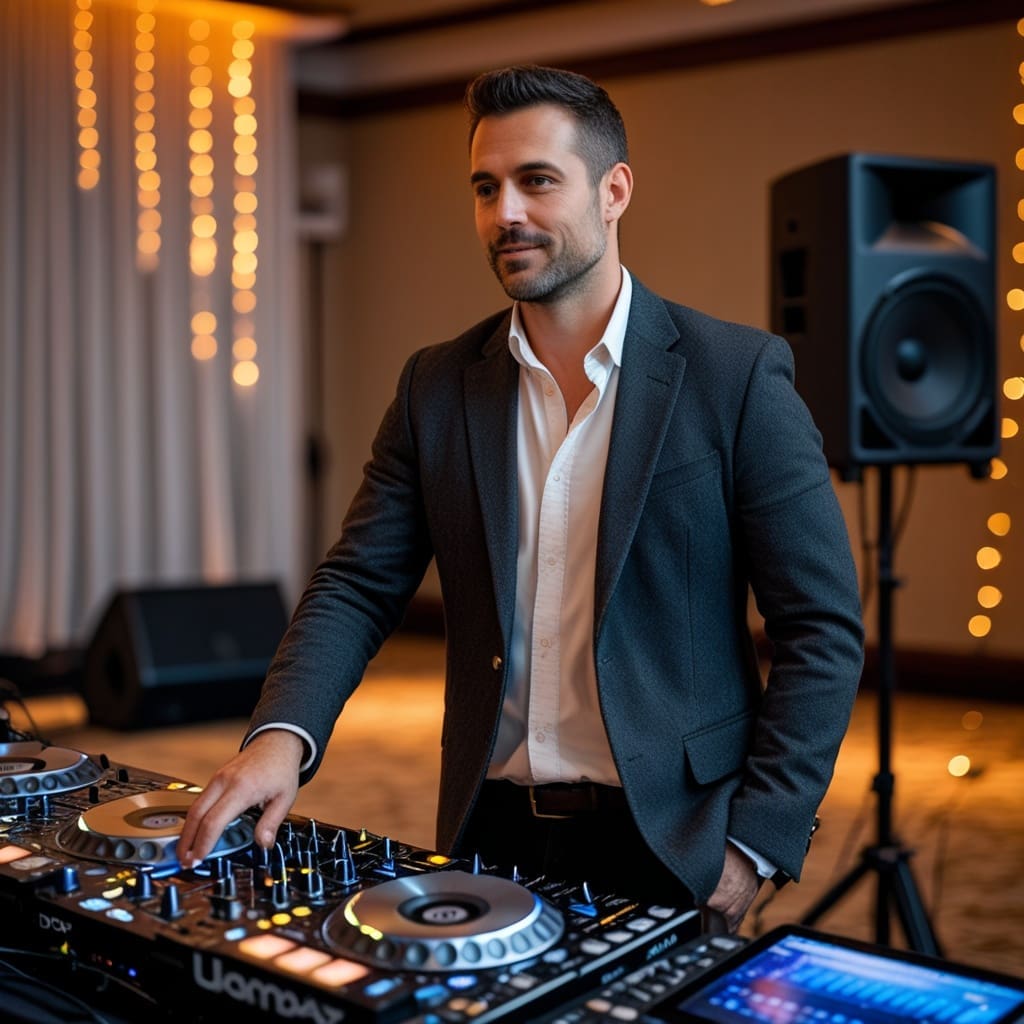
On the hosting side, the DJ often functions as your unofficial stage manager. That includes making announcements, introducing executives or award winners, cuing video presentations at the correct moment, and keeping the printed agenda on schedule even when speeches run long. This coordination requires a planning conversation well before the event, not improvisation on the night itself. Many companies looking for reliable, repeatable entertainment across multiple annual events end up building a relationship with one vendor rather than rebooking a new act every year. If you want a closer look at how our corporate DJs handle everything from client galas to team celebrations, that page outlines the specific formats we cover most often.
When Does a Company Actually Need One?
Nearly any gathering with more than a handful of employees benefits from professional sound and pacing, but a few formats show up constantly on booking calendars.
- Holiday and year-end parties: High-energy playlists, open dance floors, and a countdown-style close to the night.
- Employee appreciation events: Lower-key background music that supports conversation instead of competing with it.
- Award ceremonies and galas: Precise music cues timed to the second, plus formal MC announcements for each honoree.
- Product launches and brand activations: Curated sets that match brand tone, sometimes paired with custom lighting in company colors.
- Outdoor team-building events: Weather-ready, portable sound systems and interactive moments that keep mixed-age groups engaged.
- Client entertainment and VIP receptions: Sophisticated background sets pitched low enough for business conversation.
The difference between these formats is the energy arc of the night, and that arc gets mapped during the planning call, not improvised on the spot. A DJ who treats every booking the same way, regardless of format, is usually the wrong hire for corporate work.
What Does It Cost to Hire a Corporate Event DJ?
Pricing depends on event length, guest count, and how much equipment and staffing the format requires, but real ranges exist rather than vague estimates. A short three-hour employee appreciation reception with basic sound typically runs $600 to $1,200. A five- to six-hour holiday party or gala with full MC hosting, dance lighting, and wireless microphones for speakers usually falls between $1,500 and $3,500. Larger product launches or multi-room conferences that require staging, multiple sound zones, or custom branding often land between $3,500 and $6,000 or more.
Several factors push a quote toward the higher end of any range:
- Guest count above 200: Larger rooms need additional line array speakers, adding $300 to $800 to a base quote.
- Extra MC hours: Award ceremonies with 15 or more honorees often add 30 to 60 minutes of paid setup and rehearsal time.
- Weekend or holiday-season dates: December bookings, the busiest month for corporate entertainment, often carry a 10 to 20 percent seasonal premium.
- Add-on equipment: Intelligent lighting, photo booths, and monogram projection are typically quoted separately, adding $200 to $900 each.
Because quotes shift with these variables, it helps to get a feel for how corporate bookings are quoted before you request a formal proposal, so you can budget accurately for your specific headcount and venue.
How to Hire a Corporate Event DJ: A Six-Step Process
Booking corporate entertainment is not the same process as booking a wedding DJ off a review site. Follow these steps in order to protect both your event and your reputation as the planner.
- Confirm corporate-specific experience. Ask for at least two or three references from company events, not just weddings, since the skill sets differ.
- Verify backup equipment. A professional should travel with a second laptop, a spare amp or powered speaker, and backup cabling. One-of-everything setups are a liability at a 300-person gala.
- Request proof of insurance. Most corporate venues require a $1 million to $2 million general liability certificate before a vendor can load in equipment. Annual premiums for DJs typically run $250 to $500, and per-event certificates cost $100 to $250 if the DJ does not carry a standing policy.
- Review the written contract. It should spell out arrival time, setup window, overtime rates, and cancellation terms in plain language.
- Complete a planning questionnaire and pre-event call. This is where you confirm the timeline, any do-not-play list, and MC talking points, ideally two to four weeks before the date.
- Lock in the date with a signed agreement and deposit. Most vendors require 25 to 50 percent down to hold a date, particularly during the November and December holiday season when calendars fill quickly.
Per the International Live Events Association’s 2026 member survey, 61 percent of corporate planners rank vendor insurance and signed contracts among their top three hiring requirements, ahead of price. That single data point explains why the cheapest quote is rarely the safest choice for a company event.
A DJ who cannot produce proof of insurance or a written contract is not a budget option. That DJ is a risk you are choosing to accept on behalf of your employer.
Music Programming and Reading the Room
Corporate audiences are harder to read than a typical wedding crowd because the guest list usually spans several generations and a wide range of musical taste. A skilled DJ builds the night in phases rather than shuffling a single playlist for four hours straight. Arrival and cocktail hour call for lighter, mid-tempo background tracks around 100 beats per minute. As the room fills, tempo and volume rise gradually, and if dancing is part of the agenda, the highest-energy set typically lands in the back half of the night, after formal remarks and award segments are finished.
Speeches and award announcements get clean, low-volume transitions so every word is audible from the back row, which requires the DJ to control both music and microphone levels in real time. Explicit lyrics are filtered by default in corporate settings unless a client specifically requests otherwise, which happens rarely. Genre variety, blending classic hits with current chart music and the occasional era-specific pivot, keeps a mixed-age crowd engaged without alienating any one group.
Add-On Services That Elevate a Holiday Party or Gala
A DJ is the anchor of corporate entertainment, but pairing that service with a few extras often turns a good party into one people mention at the next all-hands meeting. Consider these additions when the budget allows:
- 360 photo booth: A rotating platform camera that captures slow-motion video clips guests can share instantly, often the most-photographed feature at a holiday party.
- AI photo booth: Generates digitally enhanced, branded images featuring your company logo or event theme, typically delivered to guests within seconds.
- Intelligent lighting: Programmable LED fixtures and moving heads synced to the music, often matched to brand colors for a product launch or milestone anniversary.
- Custom monogram projection: Your company name or logo projected onto a dance floor or backdrop, a detail that photographs well for internal newsletters and social media.
Any of these additions can be bundled with a DJ booking rather than sourced separately, which usually simplifies both logistics and the final invoice.
Ready to Book Your Corporate Event DJ
Choosing the right entertainment partner protects both your budget and your reputation as the event planner. Once you have confirmed experience, insurance, and a clear contract, the next step is simple: reach out with your date and guest count so the vendor can hold your spot before the calendar fills. You can start the process of reserving a DJ for your next company event as soon as you have a working date and venue in hand.
Frequently Asked Questions
How far in advance should you book a corporate event DJ?
Book six to twelve weeks ahead for most events, and three to four months ahead for December holiday parties. Corporate calendars for entertainment vendors fill quickly between November and mid-December, so waiting until the last month often limits you to whoever still has an open date rather than your first choice.
Can a corporate DJ also serve as the event’s MC?
Yes, most professional corporate DJs handle both roles as part of a standard booking. That includes welcoming guests, introducing speakers, announcing award recipients, and keeping the printed agenda on schedule, which removes that responsibility from an internal employee.
What is the average cost difference between a wedding DJ and a corporate event DJ?
Corporate bookings often run 10 to 20 percent higher than a comparable wedding package. The gap reflects added MC coordination, AV integration with presentations, and the liability insurance corporate venues require, none of which are typically demanded at a private wedding reception.
Do corporate venues really require a DJ to carry liability insurance?
Many do, particularly hotels, convention centers, and country clubs. A standard $1 million to $2 million general liability certificate is the most common request, and a DJ without one may be turned away at load-in regardless of talent or price.
What happens if a DJ’s equipment fails during a company event?
A professional DJ carries backup gear and switches over within minutes, minimizing disruption. This is why verifying backup equipment during the hiring process matters more than almost any other question you can ask a vendor.
Conclusion
Hiring a corporate event DJ is less about finding someone who owns good speakers and more about finding a professional who can manage sound, pacing, and live hosting under real-world pressure. The right vendor arrives with backup equipment, a signed contract, proof of insurance, and a plan built around your specific guest list and agenda. Get those fundamentals right, and the entertainment becomes the part of the event people remember for the right reasons.
Picture a 300-person product launch running on a tight schedule: keynote at 6:00, awards at 6:45, dancing by 8:00. A DJ who has only worked weddings might not know how to fade music under a live mic cue or cut a track cleanly when a speaker runs long. A DJ with corporate experience will have a second wireless mic ready before you even ask, will watch the room instead of a phone, and will adjust the set list if half the crowd leaves early for another commitment. That kind of judgment only comes from doing this type of event repeatedly, not from a general entertainment background.
Before you sign anything, run through a short checklist:
- Ask for two or three references from past corporate clients, not just weddings.
- Confirm they carry liability insurance, many venues require a $1 million policy before load-in.
- Get backup gear in writing: a second sound system, spare cables, and a plan if a laptop fails mid-event.
- Clarify hosting duties. Will they read the run-of-show, introduce speakers, or just play music between segments?
- Lock in overtime rates and cancellation terms before the deposit changes hands.
Budget matters too, but it shouldn’t be the deciding factor. A DJ charging $800 for a four-hour corporate mixer and one charging $2,500 for a 500-person gala with full AV support are solving different problems. Match the vendor’s experience and equipment to the size and formality of your event, not just the price tag. A quick phone call before booking, where you describe the agenda and ask how they’d handle it, usually tells you more than any portfolio or price sheet ever will.