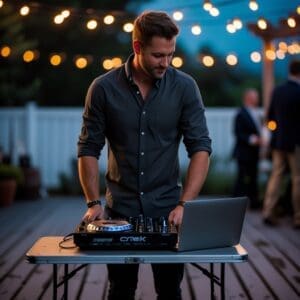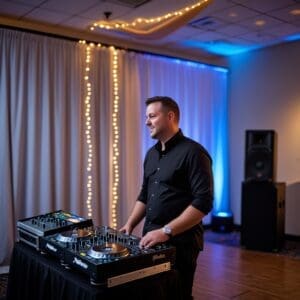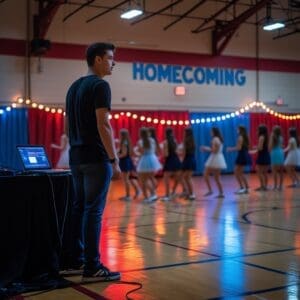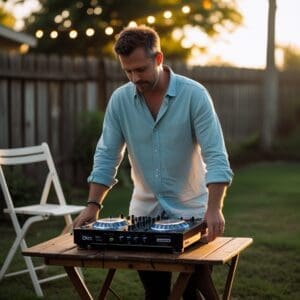
Your wedding DJ does more than play music. They control the energy of your entire reception, coordinate announcements, manage your timeline, and keep guests on the dance floor. A great DJ makes your celebration feel seamless. A bad one makes it feel awkward.
The challenge is that most couples have never hired a DJ before. You don’t know what questions to ask, what a fair price looks like, or how much involvement a DJ should have in planning your day. This guide covers all of it so you can book with confidence and avoid the most common mistakes.
Key Takeaways
- DJs do far more than play songs — they act as emcees, timeline managers, and energy directors throughout your entire reception.
- Average wedding DJ cost ranges from $1,000 to $2,500 — with premium DJs in major cities charging $3,000 to $5,000 or more.
- Start booking 9 to 12 months out — experienced wedding DJs get reserved fast, especially for peak season dates (May through October).
- Ask about backup equipment and contingency plans — gear failures happen, and professionals always carry redundant systems.
- Your DJ coordinates entrance music and reception flow — from grand entrances to last dance, they cue every transition.
- A detailed planning meeting 4 to 6 weeks before the wedding — ensures your must-play and do-not-play lists are locked in.
What Does a Wedding DJ Actually Do Beyond Playing Music?
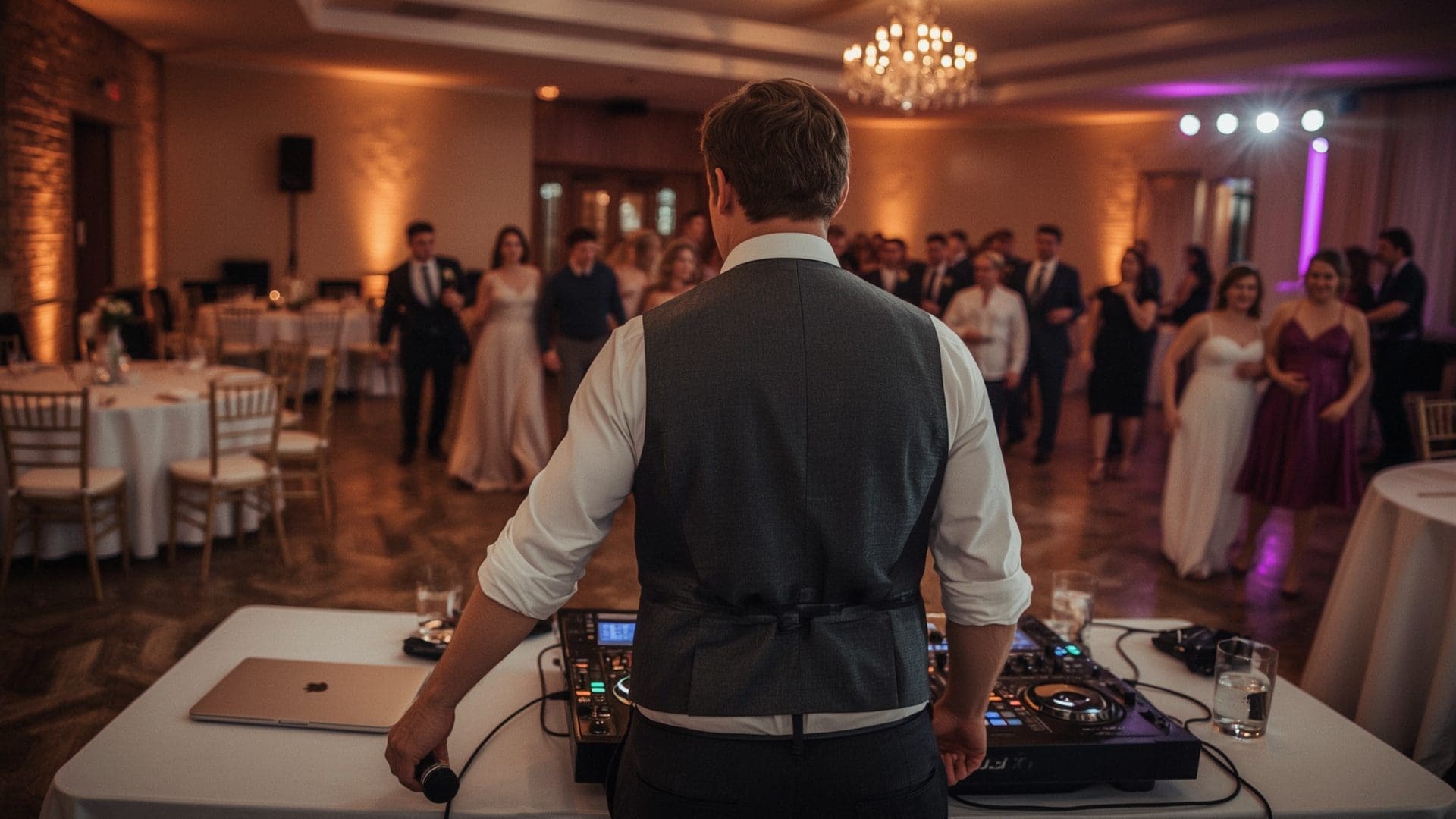
Quick Answer: A wedding DJ serves as emcee, timeline coordinator, and atmosphere director. They announce key moments, manage sound for toasts and speeches, cue entrance music, read the crowd’s energy, and keep the reception flowing on schedule from cocktail hour through the last song.
Think of your DJ as the stage manager of your wedding. The photographer captures moments. The planner organizes logistics. But the DJ controls what guests experience in real time.
Emcee and Announcements
Your DJ introduces the wedding party, announces the first dance, calls guests to dinner, and directs bouquet and garter tosses. Their microphone presence sets the tone. A skilled emcee sounds natural and warm, not like a radio host forcing energy.
Timeline Management
DJs work from a detailed timeline synced with your wedding planner, caterer, and photographer. They know when to cut music for toasts, when to ramp up energy for dancing, and when to signal transitions. Without this coordination, receptions stall or feel rushed.
Sound System Operation
Beyond the playlist, your DJ manages all audio. This includes wireless microphones for speeches, adjusting volume for different room zones, and ensuring music quality matches the venue’s acoustics. Many DJs also provide ceremony sound if booked for the full day.
Crowd Energy Reading
This is the skill that separates average DJs from exceptional ones. Reading a crowd means knowing when to shift genres, when to slow things down, and when to build energy for a peak moment. No playlist app can do this. It requires experience and instinct.
How Much Does a Wedding DJ Cost?
Quick Answer: Most couples spend between $1,000 and $2,500 for a wedding DJ. Prices vary by region, experience level, hours of coverage, and extras like uplighting or photo booths. Premium DJs in major metro areas charge $3,000 to $5,000 or more.
| DJ Tier | Typical Cost | Experience Level | Typical Inclusions | Best For |
|---|---|---|---|---|
| Budget | $500–$1,000 | 1–3 years | Basic sound, 4–5 hours | Casual or small weddings |
| Mid-Range | $1,000–$2,500 | 3–7 years | Emcee, planning meeting, 5–6 hours, wireless mics | Most weddings |
| Premium | $2,500–$5,000 | 7–15+ years | Full coordination, lighting design, ceremony + reception | Large or high-end weddings |
| Elite/Destination | $5,000–$10,000+ | 15+ years, brand name | Custom mixes, multi-room sound, full production | Luxury or destination weddings |
What Drives DJ Pricing Up or Down?
Several factors affect your final quote. Hours of coverage matter most. A four-hour reception costs less than an eight-hour full-day package covering ceremony, cocktails, and reception. Geographic location plays a large role too. A DJ in Manhattan charges more than one in rural Tennessee.
Equipment quality is another factor. DJs who invest in premium speakers, subwoofers, intelligent lighting, and backup systems price their services higher. You’re paying for reliability, not just volume.
Hidden Costs to Watch For
Ask about travel fees if your venue is more than 30 miles from the DJ’s base. Overtime rates typically run $150 to $300 per hour if your reception runs late. Some DJs charge separately for ceremony sound, cocktail hour music, or uplighting packages. Get every cost in writing before signing.
When Should You Start Looking for a Wedding DJ?
Quick Answer: Start researching wedding DJs 9 to 12 months before your date. Top-rated DJs book out quickly during peak wedding season. By 6 months out, your top choices may already be taken, especially for Saturday evenings in summer and fall.
The booking timeline matters more than most couples realize. DJs can only work one event per day. If your wedding falls on a popular Saturday in June, September, or October, your options shrink fast.
Here is a practical timeline to follow:
- 12 months out: Research DJs, read reviews, watch demo videos
- 9–10 months out: Schedule consultations with your top 3–5 candidates
- 8 months out: Book your DJ and sign the contract
- 4–6 weeks before: Hold a detailed planning meeting to finalize music, timeline, and logistics
- 1 week before: Confirm load-in time, contact info, and venue access details
What Questions Should You Ask a Wedding DJ Before Booking?
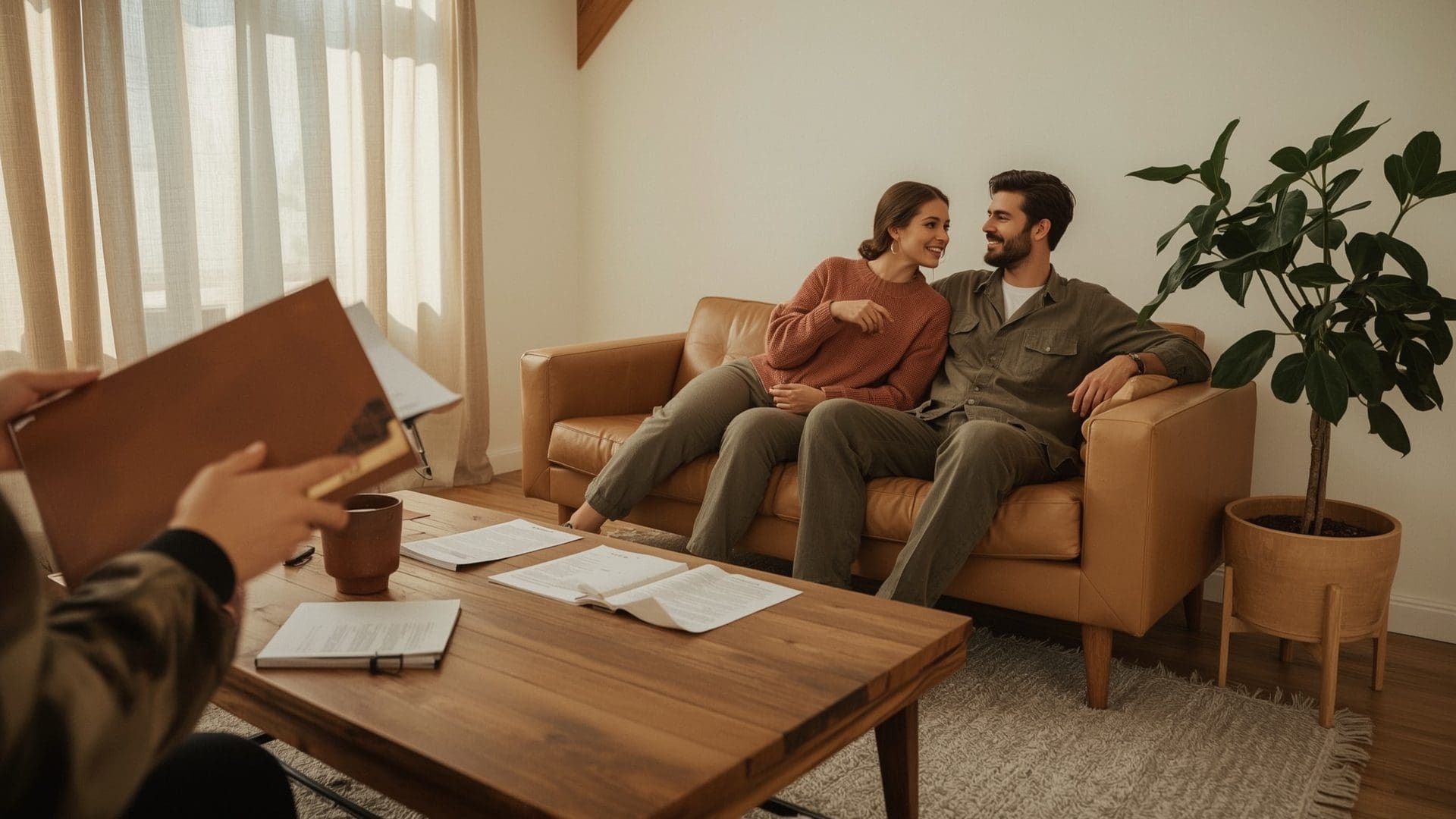
Quick Answer: Ask about their experience with weddings specifically, backup equipment plans, how they handle music requests, their emcee style, and whether they carry liability insurance. These questions reveal professionalism that demo mixes alone cannot show.
Experience and Specialization Questions
Not all DJs are wedding DJs. A club DJ or corporate event DJ may not understand wedding-specific flow. Ask how many weddings they have performed at. Look for someone with at least 50 weddings under their belt. Ask about the largest wedding they have managed and the most common venue types they work in.
Music and Style Questions
Ask how they build a playlist. Do they rely on a standard set list, or do they customize based on your preferences? A good wedding DJ blends your must-play list with crowd-responsive selections. Ask if they take guest requests during the reception and how they handle requests for songs on your do-not-play list.
Logistics and Professionalism Questions
These questions protect you from problems on your wedding day:
- Do you carry backup equipment (speakers, laptop, cables, microphones)?
- What happens if you have a personal emergency and cannot make it?
- Do you have liability insurance, and does your coverage meet my venue’s requirements?
- What do you wear? Can I specify a dress code?
- Will you visit the venue before the wedding to check acoustics and power access?
- How early do you arrive for setup?
| Question Category | Key Question | Why It Matters | Red Flag Answer |
|---|---|---|---|
| Experience | How many weddings have you DJed? | Proves wedding-specific skill | “I mostly do clubs but weddings are similar” |
| Backup Plan | What is your contingency if you cannot attend? | Prevents day-of disasters | “That has never happened” |
| Equipment | Do you carry redundant gear? | Gear failure is common | “My setup is reliable, I don’t need backups” |
| Insurance | Do you carry liability insurance? | Most venues require it | “I can look into getting it” |
| Music Process | How do you build the playlist? | Shows collaboration approach | “I know what works, trust me” |
| Emcee Style | Can I hear a recording of you emceeing? | Reveals mic presence | “I don’t have recordings” |
How Does a Wedding DJ Coordinate Entrance Music and Introductions?
Quick Answer: Your DJ works from a cue sheet listing each member of the wedding party, their entrance song, and the exact moment to hit play. They coordinate with your planner or venue coordinator to time announcements perfectly, building energy from bridesmaids and groomsmen up to the grand couple introduction.
Building the Entrance Cue Sheet
During your planning meeting, you will create a detailed cue sheet together. This document lists every person being introduced, the pronunciation of their names, their entrance song or segment, and the order of introductions. Most couples follow this sequence: parents, grandparents, wedding party pairs, maid of honor, best man, and then the newlyweds.
Timing and Energy Progression
Professional DJs build energy through the entrance sequence. Early introductions might use a mid-energy song. The final announcement of the couple uses the highest-energy track. Your DJ coordinates the timing so each pair enters right on beat, creating a cohesive and exciting moment.
Common Entrance Music Mistakes
Choosing songs that are too long is a frequent issue. Your DJ should know how to loop or edit tracks so the energy stays tight. Another mistake is picking songs with slow intros. Your DJ will cue the track to the right starting point so energy hits immediately when the doors open.
How Does a DJ Manage Reception Flow From Start to Finish?
Quick Answer: A wedding DJ follows a structured reception timeline covering cocktail hour, introductions, first dance, dinner service, toasts, special dances, open dancing, and the send-off. They use music transitions and announcements to guide guests through each phase naturally.
Cocktail Hour
Your DJ plays background music at a lower volume during cocktail hour. The goal is ambiance, not dancing. Jazz, acoustic covers, or lounge music work well. Your DJ adjusts volume so guests can mingle and talk without shouting.
Dinner Service
During dinner, music stays at background levels. Your DJ manages microphone handoffs for toasts, blesses, and thank-you speeches. They monitor audio levels so every guest can hear speeches clearly, even at the back of the room.
Open Dancing and Energy Peaks
This is where your DJ earns their fee. After special dances and formalities, the dance floor opens. Your DJ reads the room and builds energy in waves. They mix genres to pull different age groups onto the floor. A skilled DJ can keep 80% of guests dancing for two hours straight by knowing when to peak and when to give the crowd a breather.
Last Dance and Send-Off
Your DJ announces the last dance and coordinates with your photographer and planner for the send-off. Whether you are doing a sparkler exit, bubble send-off, or simply walking out, your DJ cues the final song and manages the moment so it feels intentional and memorable.
What Equipment Should a Professional Wedding DJ Bring?
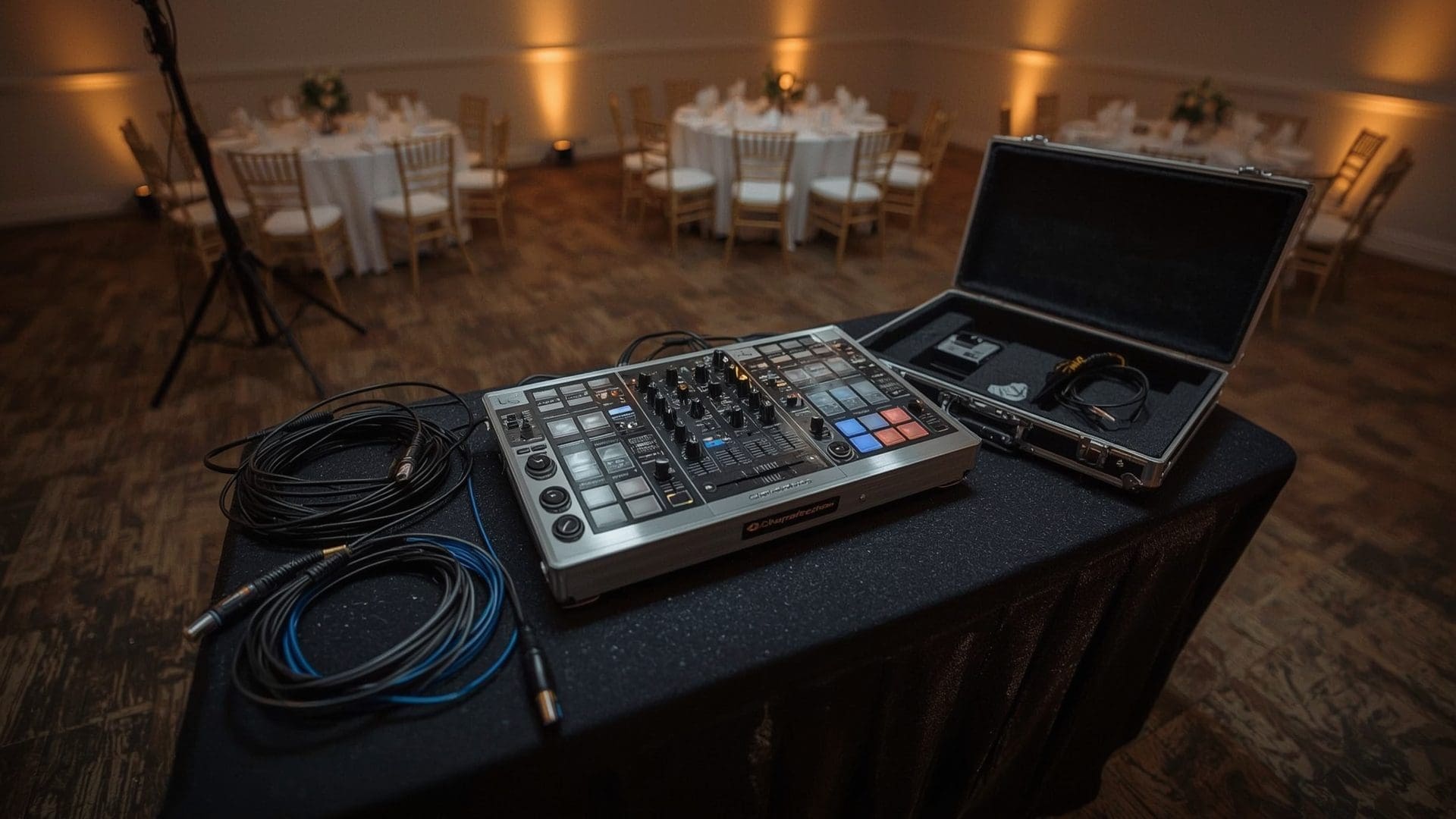
Quick Answer: A professional wedding DJ brings a primary and backup laptop, DJ controller, powered speakers matched to the venue size, subwoofer, wireless microphones, a mixer, cabling, power strips with surge protection, and backup drives with their music library. Redundancy in critical gear is non-negotiable.
| Equipment | Purpose | Professional Standard | Backup Required? |
|---|---|---|---|
| Powered Speakers | Main sound output | QSC, JBL, EV (1,000W+ per side) | Yes |
| Subwoofer | Bass reinforcement | 12″ or 15″ powered sub | Recommended |
| Wireless Microphones | Toasts, announcements | Shure or Sennheiser (UHF band) | Yes, minimum 2 |
| DJ Controller | Mixing and playback | Pioneer DDJ, Denon Prime | Backup laptop + software |
| Uplighting | Ambient room lighting | LED pars (battery or DMX) | Optional add-on |
| Mixer | Audio signal routing | 4-channel minimum | Yes |
Why Backup Equipment Matters
Hardware fails. Laptops crash. Cables short out. A professional DJ brings duplicates of every critical component. Ask your DJ specifically what backup gear they carry. If the answer is “nothing,” that is a dealbreaker. One equipment failure without a backup can silence your entire reception.
Should You Create a Must-Play and Do-Not-Play List?
Quick Answer: Yes. A must-play list of 15 to 25 songs gives your DJ a clear picture of your taste and non-negotiable picks. A do-not-play list prevents songs that kill the mood for you. Together, these lists guide your DJ without micromanaging every track.
How to Build a Must-Play List
Focus on songs that mean something to you as a couple and songs you absolutely want to hear. Don’t try to program the entire night. Give your DJ 15 to 25 must-plays and let them fill the gaps based on crowd energy. Include the genre mix you love so your DJ understands your vibe.
The Do-Not-Play List
This list is just as important. If certain songs have bad memories, feel overplayed, or just don’t fit your style, tell your DJ. Common entries include the “Chicken Dance,” “Macarena,” and novelty songs that feel dated. Your DJ should respect this list completely.
Handling Guest Requests
Decide in advance whether your DJ should accept live requests from guests. Some couples love the spontaneity. Others want tight control over the vibe. A third option: tell your DJ to accept requests but filter them through your must-play and do-not-play lists before playing anything.
What Is the Difference Between a Wedding DJ and a Playlist or Spotify?
Quick Answer: A wedding DJ reads the room, adjusts in real time, serves as emcee, manages sound equipment, coordinates with vendors, and creates seamless transitions. A Spotify playlist plays songs in order with no awareness of what is happening in the room.
The cost difference tempts some couples. But a playlist cannot lower the volume when Grandma is giving a toast. It cannot notice that the dance floor emptied and switch genres to bring people back. It cannot announce your entrance or manage wireless mic handoffs for speeches.
A playlist also cannot troubleshoot sound issues. If a speaker buzzes, a Bluetooth connection drops, or the venue’s power supply causes interference, you need a professional on-site who can fix it in seconds.
How Do You Spot a Great Wedding DJ Versus an Average One?
Quick Answer: Great wedding DJs show polished demo videos of real weddings, have dozens of verified reviews mentioning dance floor energy, carry professional-grade equipment with backups, ask detailed questions about your vision, and communicate proactively throughout the planning process.
Green Flags
- They ask more questions about your wedding than you ask about them
- They provide a structured planning process with clear milestones
- They have video of themselves emceeing, not just mixing music
- Their reviews specifically mention keeping the dance floor full
- They carry liability insurance without being asked
- They have a professional website and contract
Red Flags
- No written contract
- No backup equipment
- Cannot provide references from recent weddings
- Dismissive about your music preferences
- Prices far below market average (often signals inexperience)
- Does not ask about your venue, timeline, or vision
Can Your Wedding DJ Also Handle Ceremony Music?
Quick Answer: Many wedding DJs offer ceremony sound packages that include a separate speaker setup for the ceremony site, wireless microphones for the officiant, and processional and recessional music. Booking one DJ for the full day simplifies coordination and often costs less than hiring separately.
Ceremony sound has different requirements than reception sound. The volume is lower. The speaker placement focuses on the seating area, not a dance floor. Your DJ will set up a separate system at the ceremony site and transition equipment to the reception space during cocktail hour.
If your ceremony and reception are in different locations, ask about travel time and whether the DJ can realistically set up both. Some DJs bring an assistant to manage dual setups.
How Do You Work With Your DJ During the Planning Process?
Quick Answer: After booking, most DJs schedule a detailed planning meeting 4 to 6 weeks before your wedding. During this meeting, you finalize the timeline, entrance order, music selections, special dances, announcements, and any venue-specific logistics like power access and setup time.
What the Planning Meeting Covers
Your planning meeting is where everything comes together. Expect to spend 60 to 90 minutes covering these areas:
- Reception timeline with exact start times for each segment
- Introduction order and name pronunciations
- Must-play and do-not-play lists
- Special dance songs and any planned surprises
- Microphone needs for toasts and speeches
- Venue layout, DJ booth placement, and power access
- Vendor contact info (planner, photographer, caterer, venue coordinator)
Day-Of Communication
On your wedding day, your DJ communicates primarily with your wedding planner or venue coordinator. You should not have to manage your DJ during the reception. Before the day, make sure your DJ has direct contact information for every key vendor. This allows seamless coordination without pulling you away from your celebration.
What Lighting Options Do Wedding DJs Offer?
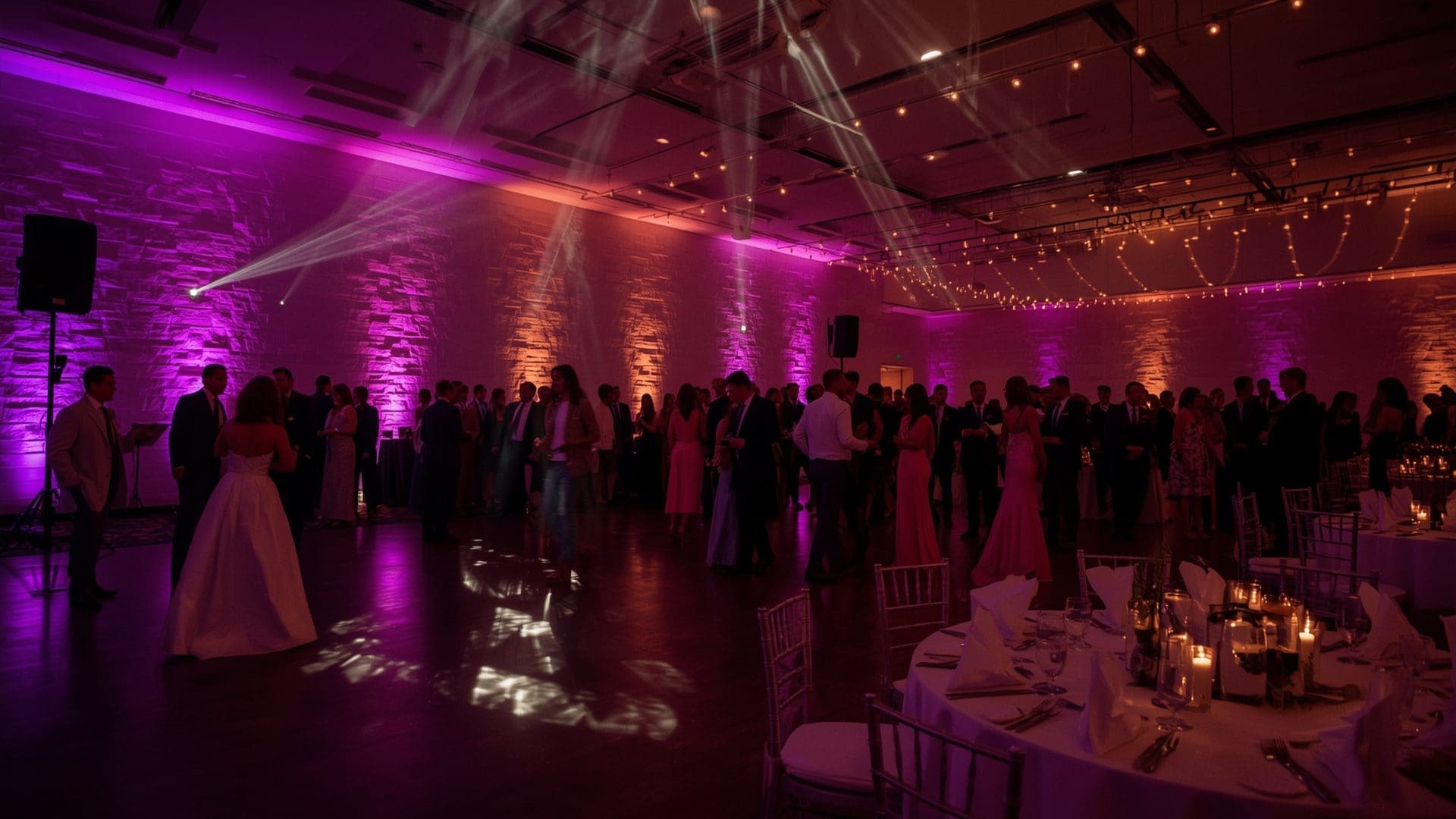
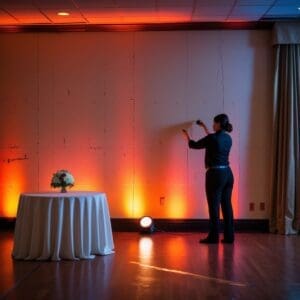
Quick Answer: Most professional DJs offer uplighting, dance floor lighting, monogram projection, and intelligent moving lights as add-on packages. Uplighting transforms a room’s ambiance for $300 to $800, while full lighting production with moving heads and custom gobos ranges from $1,000 to $3,000.
| Lighting Type | Average Cost | Effect | Best For |
|---|---|---|---|
| Uplighting (LED pars) | $300–$800 | Washes walls in color | Ballrooms, banquet halls, tents |
| Dance Floor Lights | $150–$400 | Moving patterns on dance floor | Open dancing segment |
| Monogram/Gobo Projection | $200–$500 | Projects names or initials | Grand entrance, sweetheart table |
| Intelligent Moving Heads | $500–$1,500 | Programmable beam effects | Large venues, high-production weddings |
| String/Bistro Lights | $400–$1,200 | Warm overhead ambient glow | Outdoor receptions, rustic venues |
Lighting is one of the highest-impact upgrades you can add. A room with uplighting feels completely different from the same room with standard overhead fluorescents. Ask your DJ for photos or video of their lighting work at similar venues before adding this to your package.
How Do You Handle the Contract and Payment Schedule?
Quick Answer: A professional DJ contract should specify the date, hours of coverage, equipment provided, overtime rates, cancellation policy, and total cost. Most DJs require a 25% to 50% deposit at signing with the balance due one to two weeks before the wedding.
What Your Contract Should Include
- Event date, start time, and end time
- Exact services included (emcee, ceremony, cocktail hour, reception)
- Equipment provided and any add-ons (lighting, photo booth)
- Overtime rate per hour
- Cancellation and refund policy
- Backup DJ clause (what happens if they cannot perform)
- Total cost, deposit amount, and payment due dates
Payment Red Flags
Be cautious of DJs who demand full payment upfront with no refund policy. A standard structure is 25% to 50% at contract signing and the remainder two weeks before the wedding. Avoid cash-only arrangements with no paper trail. Always pay by check, credit card, or digital transfer so you have documentation.
Frequently Asked Questions
How long should a wedding DJ play during the reception?
Most wedding DJ packages cover 4 to 6 hours, which handles introductions through the last dance. If your reception includes a cocktail hour and after-party, book 6 to 8 hours. Overtime typically costs $150 to $300 per additional hour.
Can a wedding DJ mix different music genres throughout the night?
Absolutely. Skilled DJs use beatmatching and creative transitions to blend genres smoothly. They might transition from Motown classics during dinner to pop hits for open dancing and then shift to hip hop or Latin music to pull different age groups onto the floor.
Should you tip your wedding DJ?
Tipping is not mandatory but appreciated when your DJ exceeds expectations. A common tip ranges from $50 to $200 or 10% to 15% of the total fee. Hand the tip in an envelope to the DJ or their assistant at the end of the night.
What is the difference between a DJ and an MC at a wedding?
An MC (master of ceremonies) handles speaking duties like announcements and introductions. Most professional wedding DJs serve as both DJ and MC. Some couples hire a separate MC, such as a friend or family member, to handle speaking while the DJ focuses on music and sound.
Do wedding DJs provide photo booths?
Many DJ companies offer photo booth rentals as add-on packages, typically ranging from $400 to $1,200 for 3 to 4 hours. These packages usually include a booth attendant, props, and digital or printed photo strips. Bundling with your DJ often saves money compared to hiring a separate photo booth vendor.
Can you hire a wedding DJ for just the ceremony?
Yes, many DJs offer ceremony-only packages starting at $300 to $600. This covers a portable speaker system, wireless microphone for the officiant, and processional and recessional music. It is a smart option if you plan to use a live band or playlist for the reception but want professional sound for your vows.