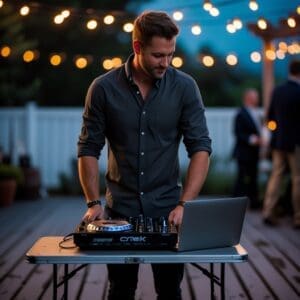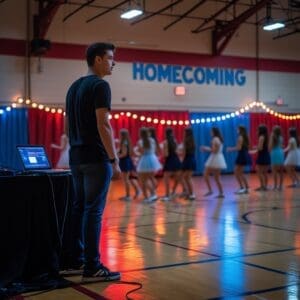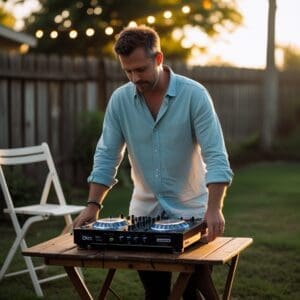
A private event DJ is a professional entertainer hired to play music, manage sound equipment, and guide the flow of a private gathering such as a birthday party, anniversary, backyard celebration, or house party. Unlike a wedding-only specialist or a club DJ, this type of entertainer builds a set specifically around your guest list, your space, and the tone you want for the night. According to WeddingWire’s Newlywed Report, roughly 71 percent of couples hire a DJ rather than a live band, and that same preference for professional DJ services has spread into everyday private celebrations across the country. Hiring one takes the guesswork out of music selection, sound levels, and pacing, so you can focus on your guests instead of your playlist.
Key Takeaways
- A private event DJ handles music, sound equipment, and event flow for parties, house gatherings, and celebrations outside the wedding industry.
- Typical rates for a private party DJ range from $400 to $1,500 for a four-hour event, according to The Knot’s Real Weddings Study and industry pricing surveys.
- Hiring a professional DJ reduces the risk of sound equipment failure, awkward silences, and mismatched music by putting a trained entertainer in charge of transitions.
- Booking three to six weeks ahead is standard for smaller private parties, though popular weekend dates can fill up two to three months out.
- Ask about backup equipment, liability insurance, and a written contract before you hire anyone for your event.
What Is a Private Event DJ?
A private event DJ is a hired entertainer who plans and performs music for a closed, invitation-only gathering rather than a public venue or nightclub. This can include birthday parties, graduation parties, retirement celebrations, holiday gatherings, engagement parties, and house parties of nearly any size. The role goes beyond pressing play on a playlist. A trained DJ reads the room, adjusts tempo and genre in real time, and often serves as the informal master of ceremonies, announcing toasts, guiding guests through activities, and keeping the night on schedule.
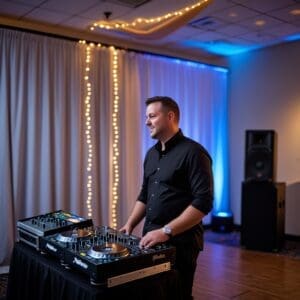
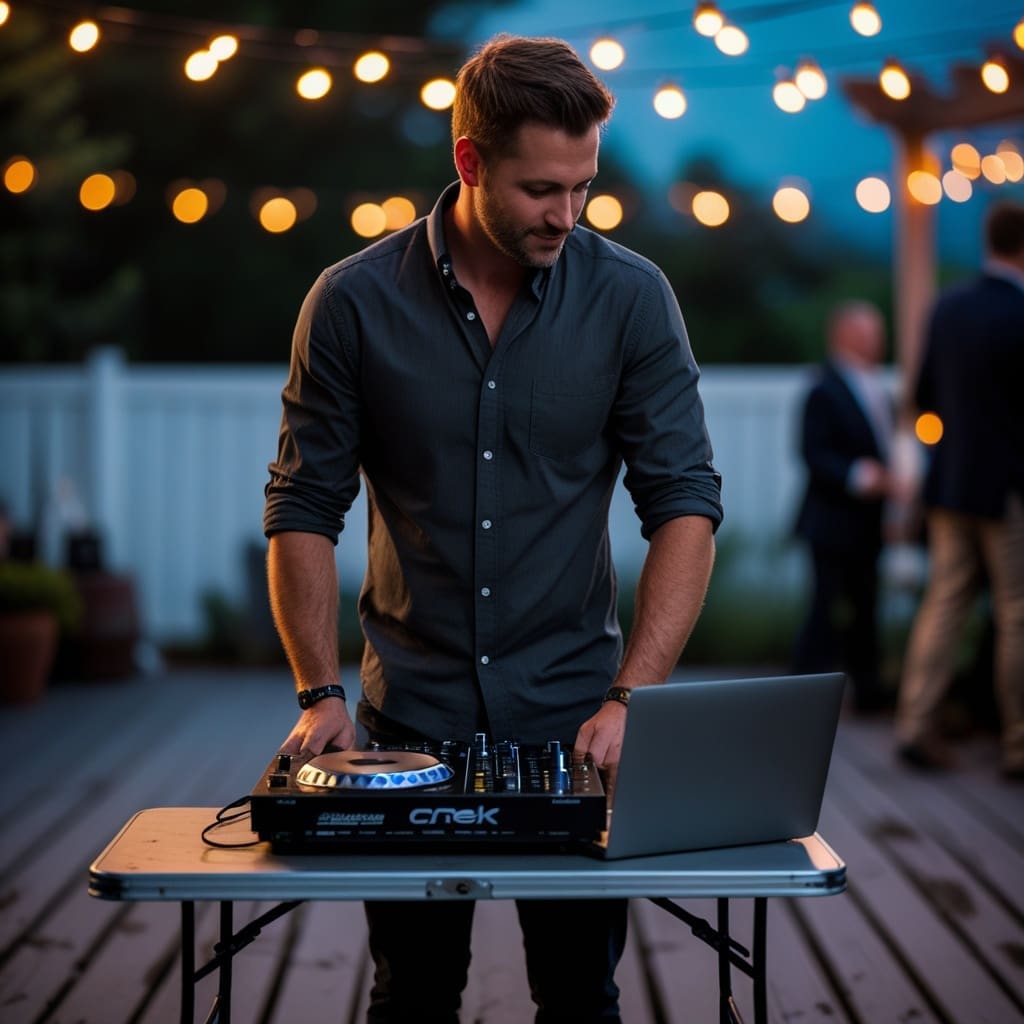
Most private event DJs bring their own sound system, wireless microphones, and sometimes basic lighting, though larger setups with uplighting or a photo booth are usually quoted separately. Many operate as independent contractors or work through a booking agency, and pricing, equipment, and experience can vary widely between the two.
What Does a Private Event DJ Actually Do?
A private event DJ’s job covers far more than song selection. On a typical four to six hour booking, the role usually includes the following:
- Pre-event planning call (30 to 60 minutes). The DJ discusses your timeline, must-play songs, do-not-play list, and any special moments like a first dance or cake cutting.
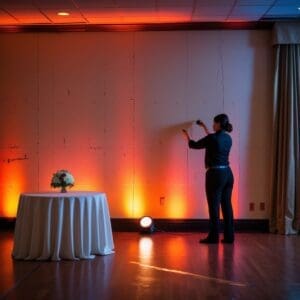
- Equipment setup (60 to 90 minutes before guests arrive). This covers speakers, a mixer, wireless microphones, and any lighting, plus a sound check to match the room’s acoustics.
- Live performance and MC duties (four to six hours). The DJ reads guest reactions, adjusts genre and tempo, and makes announcements for toasts, games, or transitions between dinner and dancing.
- Breakdown and load-out (30 to 45 minutes). Equipment is packed up after the event ends, usually without disrupting remaining guests.
For a house party specifically, this often means adapting a full performance to a smaller footprint, such as a living room, patio, or garage, without sacrificing sound quality. If you are curious about what to expect when you bring a private party DJ into your home celebration, the planning process typically starts with a walk-through of your space to determine speaker placement and volume limits for neighbors.
How Much Does It Cost to Hire a DJ for a Private Party?
A private party DJ typically costs between $400 and $1,500 for a standard four-hour event, with the national average landing around $750, according to pricing data compiled by The Knot’s Real Weddings Study and corroborated by GigSalad’s annual entertainment pricing report. Costs shift based on event size, location, add-on equipment, and how many hours you book.
- Small house party (25 to 50 guests, 3 to 4 hours): $400 to $700
- Mid-size private party (50 to 100 guests, 4 to 5 hours): $700 to $1,100
- Larger celebration (100+ guests, 5 to 6 hours): $1,100 to $1,500 or more
- Add-ons (uplighting, photo booth, extra speakers): $100 to $400 each
- Additional hours beyond the booked package: $75 to $150 per hour
Weekend dates, especially Saturdays between May and October, tend to sit at the higher end of these ranges because of demand. Weeknight or off-season bookings can come in below the average. Before locking in a date, it helps to understand what a private party DJ typically costs before you hire, since packages and included equipment differ significantly from one provider to the next.
Why Hire a DJ for Your Private Party Instead of a Playlist or Live Band?
A professional DJ solves three problems that a phone playlist or a live band cannot: sound quality, real-time adaptability, and event pacing. A Bluetooth speaker cannot read a room and switch from dinner jazz to dance music the moment the energy shifts. A live band, meanwhile, is typically locked into a set genre and cannot instantly pull up a specific requested song. According to the American Disc Jockey Association (ADJA), professional DJs carry an average catalog of over 30,000 licensed tracks, giving them far more flexibility than a curated streaming playlist or a five-piece band’s rehearsed setlist.
There is also a practical safety angle. A DJ who is a member of an organization such as the ADJA or the National Association for Catering and Events typically carries general liability insurance, often in the $1 million to $2 million coverage range, which protects you if equipment causes property damage or an electrical issue at your home. Many venues, and increasingly many homeowners’ associations, now require proof of this coverage before allowing outside entertainment on the property.
A skilled private event DJ functions less like a jukebox and more like a stage manager, quietly running the emotional arc of your evening from arrival to last dance.
DJ vs Playlist vs Live Band: A Quick Comparison
- DJ: Full song library access, real-time adjustments, MC capability, $400 to $1,500 for a typical private party.
- Playlist or Bluetooth speaker: Free to low cost, no live adjustment, no announcements, sound quality limited to consumer-grade speakers.
- Live band: $1,500 to $4,000 for a four-piece group, limited song range, no recorded-track flexibility, requires more setup space.
What Should You Look For When Hiring a DJ for a House Party?
Experience with residential settings matters more than most people expect. A DJ who mostly performs at large event halls may not know how to manage volume for a neighborhood with noise ordinances, or how to fit equipment into a living room without blocking foot traffic. Ask these questions before signing anything:
- Do you carry backup equipment? A second mixer, extra cables, and a spare speaker prevent a single equipment failure from ending the music early.
- Can I see a sample of your private party work, not just weddings? House parties require different pacing and volume management than large banquet halls.
- What is included in the quoted price? Confirm whether setup, breakdown, travel, and a planning consultation are bundled or billed separately.
- Do you have liability insurance? Request a certificate of insurance, especially if your HOA or landlord requires one.
- What happens if you are sick or unavailable? Ask about a backup DJ policy in case of illness or emergency.
A written contract should specify the date, arrival time, performance hours, total cost, deposit amount, and cancellation terms. Deposits typically run 20 to 50 percent of the total fee, due at booking, with the remainder due on or before the event date.
How Far in Advance Should You Book a Private Event DJ?
Book a private event DJ three to six weeks ahead for a small gathering, but plan two to three months out for a Saturday night celebration during peak season. Peak demand months, roughly May through October and again in December, can fill a popular DJ’s calendar quickly, particularly for graduation season in late May and June or the holiday stretch from Thanksgiving through New Year’s Eve. If you already have a date in mind, it is worth checking availability early rather than assuming a last-minute booking will work out. You can see open dates before you commit to a house party DJ so you are not left scrambling the week before your event.
Last-minute bookings, meaning inside two weeks of the event, are still sometimes possible but often come with limited equipment options or a rush fee of $50 to $150, since the DJ has less time to prepare a customized set.
How Does a DJ Handle Music Requests and Special Moments?
Most professional DJs use a pre-event planning form or call to build a request list, a do-not-play list, and a timeline of key moments such as a toast, a surprise reveal, or a cake presentation. During the event, they take live requests from guests but filter them against your preferences, so a well-meaning relative cannot derail the night with an off-brand song choice. This is one of the clearest advantages over a self-managed playlist, since a DJ can slow down, speed up, or completely pivot genres within seconds based on how the room responds.
Many DJs also bring wireless microphones for toasts or speeches, which matters more than people expect. Poor audio during a heartfelt toast is one of the most common complaints noted in post-event surveys from platforms like The Bash, a national booking marketplace for event professionals.
Ready to Book Your Private Event DJ?
Once you have a sense of your budget and guest count, the next step is confirming availability for your date and reviewing what is included in a package. Comparing two or three quotes before deciding is a reasonable approach, since pricing and included equipment can vary by several hundred dollars for what looks like the same service on paper.
Start by asking each DJ for a written breakdown, not just a total price. One quote might include a wireless microphone, dance floor lighting, and a backup sound system, while another only covers speakers and a laptop. Ask how many hours of coverage the base price includes and what the overtime rate is if your event runs long. Also find out whether setup and breakdown time count against your booked hours, since some DJs charge separately for early arrival.
Before signing anything, request a contract that spells out the date, start and end times, equipment list, and cancellation terms. A deposit is normal, usually 20 to 50 percent, but get a receipt and a clear refund policy in writing. Ask if the DJ carries liability insurance, since many venues require it before they will allow outside vendors to set up.
It also helps to schedule a short call or meeting two to four weeks before the event to finalize the timeline, music preferences, and any special announcements. This gives the DJ time to prepare a proper playlist and reduces the chance of miscommunication on the day itself. Booking three to six months out is common for weekends and peak seasons, so reach out early once you have narrowed down your top choices.
Frequently Asked Questions
How much does a private event DJ cost for a small house party?
A small house party DJ typically costs between $400 and $700 for three to four hours. This range usually covers setup, a sound system suited to a residential space, and basic music planning. Add-ons like uplighting or a photo booth cost extra, usually $100 to $400 each.
Do private event DJs bring their own speakers and equipment?
Yes, most private event DJs supply their own speakers, mixer, microphones, and cables as part of the booking. Confirm this before hiring, since some budget DJs expect the client to provide a sound system, which usually results in lower-quality audio for the price.
Can a private event DJ take live requests during the party?
Yes, taking live requests is a standard part of a private event DJ’s job. A skilled DJ balances guest requests with your pre-approved playlist and do-not-play list, so the night stays on track without ignoring what your guests want to hear.
How long does a typical private party DJ booking last?
Most private party DJ bookings run four to six hours, though shorter two-hour packages exist for smaller gatherings. Extra hours beyond the booked package usually cost $75 to $150 per hour, so it helps to plan your timeline before booking to avoid surprise fees.
What is the difference between a private event DJ and a wedding DJ?
A private event DJ covers a broader range of gatherings, while a wedding DJ specializes specifically in ceremony and reception timelines. Many professionals do both, but a dedicated wedding DJ often has more experience coordinating with photographers, planners, and formal reception traditions like a first dance or bouquet toss.
Conclusion
A private event DJ brings structure, sound quality, and real-time flexibility to a celebration that a playlist or amateur setup simply cannot match. Whether you are planning a backyard birthday party or a milestone anniversary at home, hiring an experienced professional reduces risk and lets you actually enjoy the night instead of managing the music yourself. Confirm insurance, get a written contract, and book early enough to secure your preferred date, particularly if it falls during peak season.