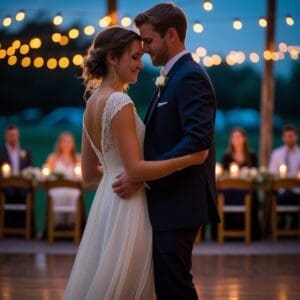
Your first dance is one of the most-watched moments of your entire wedding. Every guest stops and stares. Phones come out. And for two to four minutes, it’s just you, your partner, and whatever you decided to do with your feet.
Most couples feel the same mix of excitement and dread when they think about choreography. Some worry they have no rhythm. Others don’t know where to start. A few secretly want to do something impressive but feel like that’s out of reach.
The truth is that great first dance choreography has almost nothing to do with natural talent. It has everything to do with timing, planning, and learning a style that actually fits your song. This guide walks you through the full process — from picking a dance style to your final rehearsal the week of the wedding.
Key Takeaways
- Start lessons at least 3 months out — Most couples need 8 to 12 weekly lessons to feel comfortable with choreography.
- Your dance style should match your song’s tempo and structure — A waltz fits a song in 3/4 time; swing works for upbeat songs around 120 to 160 BPM.
- You don’t need to be a dancer — A skilled instructor builds choreography around your natural ability, not the other way around.
- Song structure determines your choreography arc — Verse, chorus, bridge, and final chorus each call for different movement intensity.
- Practice in your actual wedding shoes — Footwear changes your balance, stride, and turn execution significantly.
- A surprise element creates a memorable moment — Even one unexpected move or musical transition can turn a sweet dance into a highlight guests talk about for years.
What Is First Dance Choreography and Is It Right for You?
Quick Answer: First dance choreography is a planned sequence of dance moves set to a specific wedding song. It suits couples who want more than a slow sway and are willing to commit 8 to 12 weeks of lessons. You don’t need prior dance experience to pull it off.
A choreographed first dance is different from simply swaying in place. It’s a rehearsed routine built specifically around your song, your skill level, and the story you want to tell on the dance floor.
Choreography can be as simple as three or four connected steps with clean footwork and good posture. Or it can be a full theatrical routine with lifts, dips, style changes, and a surprise musical drop. Most couples land somewhere in the middle.
The right choice depends on two things: how much time you’re willing to invest before the wedding, and how much you enjoy being the center of attention. If performing for a crowd sounds fun, choreography pays off. If you’d rather keep it low-key, a guided slow dance with a few structured moves is also a real option worth exploring.
Choreographed vs. Guided Social Dance: What’s the Difference?
A choreographed routine has a set beginning, middle, and end that matches specific moments in the song. A guided social dance teaches you to lead and follow, respond to music, and look natural without memorizing a specific sequence. Both require lessons. Choreography requires more repetition and song-specific practice.
Which Dance Style Should You Choose for Your First Dance?
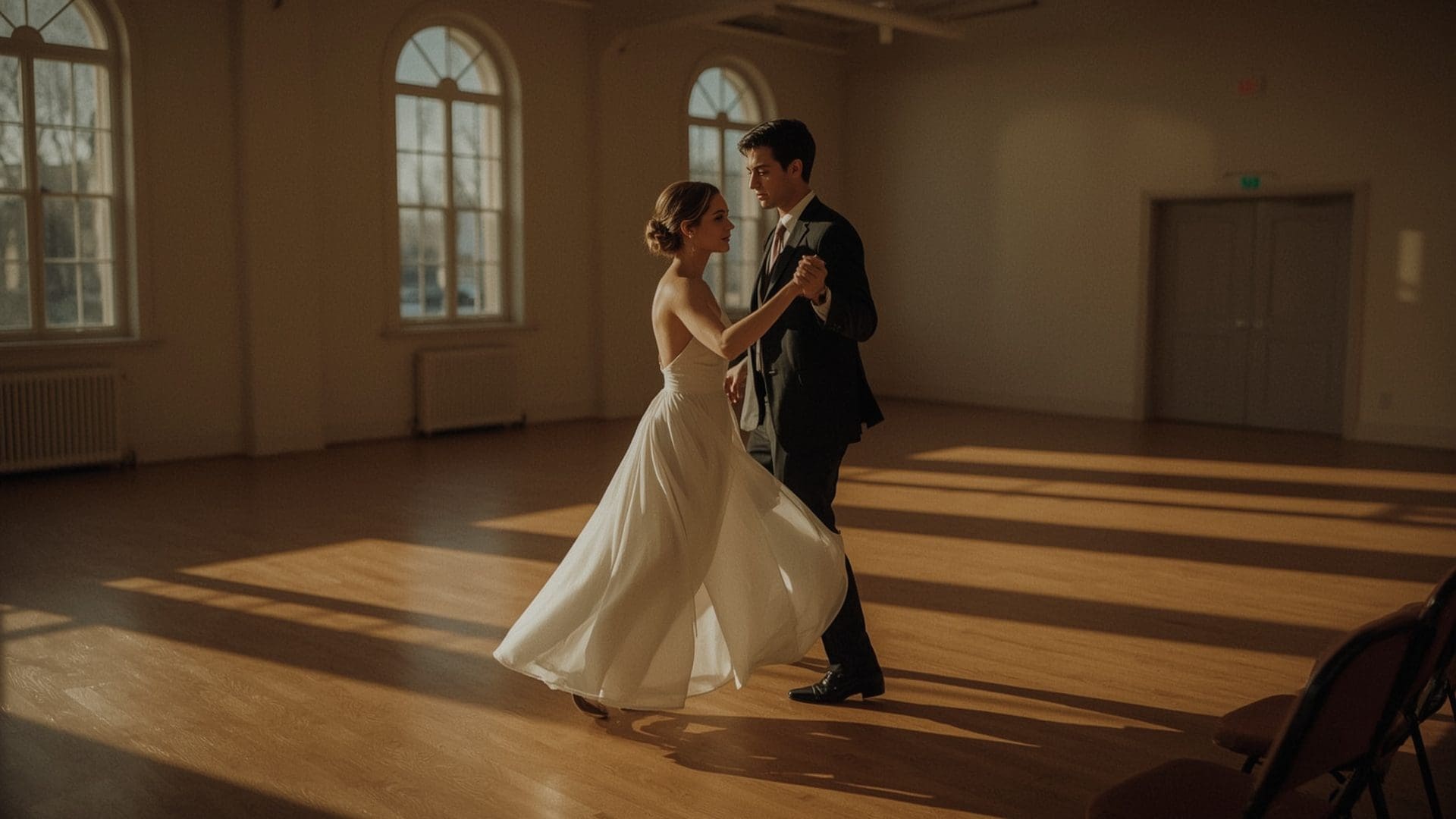
Quick Answer: Match your dance style to your song’s time signature and tempo. Waltz suits 3/4 time songs around 84 to 96 BPM. Foxtrot works for smooth 4/4 songs at 112 to 120 BPM. Swing fits upbeat songs at 120 to 160 BPM. Contemporary suits almost any tempo.
Choosing the wrong style for your song is the most common mistake couples make when planning choreography. A Viennese waltz routine looks beautiful on a song in triple time. On a song with a driving 4/4 beat, the same footwork feels off and looks awkward.
Here are the most popular first dance styles and when each one works best.
Waltz
The waltz is the most traditional first dance style. It uses a smooth, flowing movement in 3/4 time — meaning three beats per measure, with emphasis on the first beat. Songs like “Can’t Help Falling in Love” by Elvis Presley or “A Thousand Years” by Christina Perri fit naturally into waltz timing.
Waltz creates an elegant, romantic atmosphere. It’s relatively beginner-friendly because the footwork pattern (step, side, together) is simple and repeatable.
Foxtrot
The foxtrot is smooth, sophisticated, and works beautifully with slow to medium 4/4 songs. It uses a slow-slow-quick-quick timing pattern that gives it a polished, gliding quality. Think of it as the ballroom style that looks the most effortlessly refined on a dance floor.
Songs with a moderate tempo and a clear beat — around 112 to 120 BPM — pair well with foxtrot. It’s a great choice for couples who want a classic look without the triple-time complexity of a waltz.
Swing (East Coast and West Coast)
Swing is for couples who want energy and personality in their first dance. East Coast swing is bouncier and more playful. West Coast swing is smoother and fits modern pop and R&B songs well.
Both styles involve partner spins, syncopated footwork, and a call-and-response dynamic between leader and follower. Swing works best for upbeat songs in the 120 to 160 BPM range.
Contemporary / Lyrical
Contemporary choreography is the most flexible style because it’s not tied to a specific rhythm pattern. It draws from ballet, jazz, and modern dance to create movement that interprets the lyrics and emotion of a song rather than following a fixed footwork pattern.
This style works for any tempo and any song structure. It’s often chosen by couples who want something visually expressive and uniquely personal. It typically requires more rehearsal time than ballroom styles because the movements are less formulaic.
Dance Style Comparison Table
| Style | Time Signature | Ideal BPM Range | Skill Level | Best For | Avg. Lessons Needed |
|---|---|---|---|---|---|
| Waltz | 3/4 | 84–96 BPM | Beginner–Intermediate | Classic romantic songs | 8–10 lessons |
| Foxtrot | 4/4 | 112–120 BPM | Beginner–Intermediate | Smooth, elegant feel | 8–10 lessons |
| East Coast Swing | 4/4 | 136–160 BPM | Beginner–Intermediate | Upbeat, fun energy | 10–12 lessons |
| West Coast Swing | 4/4 | 120–140 BPM | Intermediate | Modern pop and R&B songs | 12–15 lessons |
| Contemporary/Lyrical | Any | 60–160 BPM | Intermediate–Advanced | Expressive, narrative routines | 12–18 lessons |
How Do You Match Choreography to Your Song’s Structure?
Quick Answer: Map your song into sections — intro, verse, chorus, bridge, final chorus — then assign movement intensity to each. Build through the verse, peak at the final chorus, and save your biggest moment for the musical climax. This creates a natural arc guests feel emotionally.
A song isn’t one flat stretch of music. It rises, falls, builds tension, and releases. Your choreography needs to do the same thing. If you dance at full energy from start to finish, the routine loses its impact. If you hold back the whole time, guests stop watching.
The key is a choreography arc — a deliberate shape to the energy of your routine that mirrors the emotional arc of the song itself.
Breaking Down Song Structure for Choreography
Most popular wedding songs follow a predictable structure. Understanding that structure lets you place your best moves exactly where the music supports them.
- Intro (0–15 seconds): Start simple. Light footwork, connection with your partner, maybe a slow turn. Let guests settle in.
- First Verse (15–45 seconds): Build slowly. Introduce your basic footwork pattern. Stay conversational in your movement.
- First Chorus (45–75 seconds): Increase energy. Add a spin or a traveling sequence. This is your first visual payoff.
- Second Verse (75–105 seconds): Pull back slightly. This contrast makes the next chorus feel bigger.
- Bridge (105–135 seconds): Use this section for something unexpected — a tempo change, a pose, a direction shift, or a brief stop.
- Final Chorus (135–180 seconds): Your biggest moment. Save your best move — a dip, a lift, a dramatic turn sequence — for here.
How to Edit Your Song Without Losing Its Feel
Most couples edit their song down from its full length. A three-and-a-half-minute song is often trimmed to two to two-and-a-half minutes for the dance floor. You can do this by removing one verse or trimming a repeated chorus, then fading into the final section.
Give your DJ or audio editor a clean MP3 with the edit clearly marked. Do all of your rehearsals with the edited version — not the original. Your muscle memory syncs to the exact audio you practice with.
When Should You Start Taking Dance Lessons?

Quick Answer: Start dance lessons at least 3 months before your wedding. This gives you time for 8 to 12 weekly lessons, a break to let skills settle, and a final run-through in the week before. Waiting until 4 weeks out leaves no room for mistakes or nerves.
Timing is one of the most overlooked parts of first dance planning. Couples who start early feel confident on the wedding day. Couples who wait too long end up rushing through choreography they haven’t fully learned, which shows.
Recommended Lesson Timeline
| Months Before Wedding | What to Focus On | Lesson Frequency | Milestone |
|---|---|---|---|
| 4–5 months out | Book instructor, choose song and style | 1 per week | First lesson completed |
| 3–4 months out | Learn core footwork and partner connection | 1–2 per week | Basic pattern mastered |
| 2–3 months out | Build full choreography sequence | 1–2 per week | Full routine drafted |
| 4–6 weeks out | Refine, polish, add styling details | 1 per week | Routine runs clean start to finish |
| 1–2 weeks out | Practice in wedding attire and shoes | Final run-through | Performance-ready |
How to Choose the Right Dance Instructor
Look for an instructor who specializes in wedding choreography specifically — not just ballroom competition training. Wedding choreography is its own skill set. A great wedding dance instructor knows how to compress learning into a short timeline, build confidence in anxious beginners, and create routines that look polished even at a beginner skill level.
Ask to see video of their previous wedding couples. Check that their style matches what you’re envisioning. Studio-based instructors typically charge $75 to $150 per hour. Private in-home instruction ranges from $100 to $200 per hour depending on location.
How Many Lessons Do You Actually Need?
Quick Answer: Most couples need 8 to 12 lessons for a clean choreographed routine. Beginners with no dance background should plan for 10 to 14 lessons. Couples with some partner dance experience can often complete a polished routine in 6 to 8 sessions.
Lesson Count by Experience Level
| Experience Level | Recommended Lessons | Estimated Cost | What You’ll Achieve |
|---|---|---|---|
| Complete beginners | 10–14 lessons | $750–$2,100 | Clean choreography with basic styling |
| Some social dancing | 8–10 lessons | $600–$1,500 | Polished routine with spins and transitions |
| Prior ballroom or partner dance | 6–8 lessons | $450–$1,200 | Full choreography with styling and a signature moment |
| Trained dancers | 4–6 lessons | $300–$900 | Complex choreography with lifts or advanced footwork |
What Makes a First Dance Choreography Routine Memorable?

Quick Answer: A memorable first dance has one signature moment guests didn’t see coming — a dip, a spin sequence, a tempo surprise, or a style shift. Clean footwork and genuine connection with your partner matter more than complexity. Guests feel authenticity before they notice technique.
The couples whose first dances get talked about at every family gathering aren’t necessarily the best dancers. They’re the ones who created a moment. That moment almost always comes from one of four things.
The Four Elements of a Standout First Dance
- A surprise element: A musical drop that triggers a style change, a dip at the peak of the final chorus, or a completely unexpected tempo shift. One unexpected move sticks in memory more than two minutes of polished footwork.
- Eye contact and connection: Couples who dance at each other rather than at the floor look like they’re actually enjoying themselves. Guests respond to that instantly.
- A clean opening and closing: The first five seconds and the last five seconds are what guests remember. Start with intention. End with stillness and a held pose.
- Song authenticity: Choreography built around a song that actually means something to you reads differently than a routine built around a song that’s just danceable. Guests can feel the difference.
Should You Add a Surprise Song Transition?
One of the most popular choreography choices in recent years is the mid-dance song transition — starting with a slow, romantic song and transitioning at the bridge into an upbeat track. This works best when both songs are genuinely meaningful to the couple and the transition is tightly choreographed to land on the exact beat change.
Tell your DJ exactly where in the song the transition happens. Give them a reference audio file with the edit already made. The last thing you want is the DJ trying to manage a live mix while you’re waiting for your cue on the dance floor.
How Do You Practice First Dance Choreography at Home?
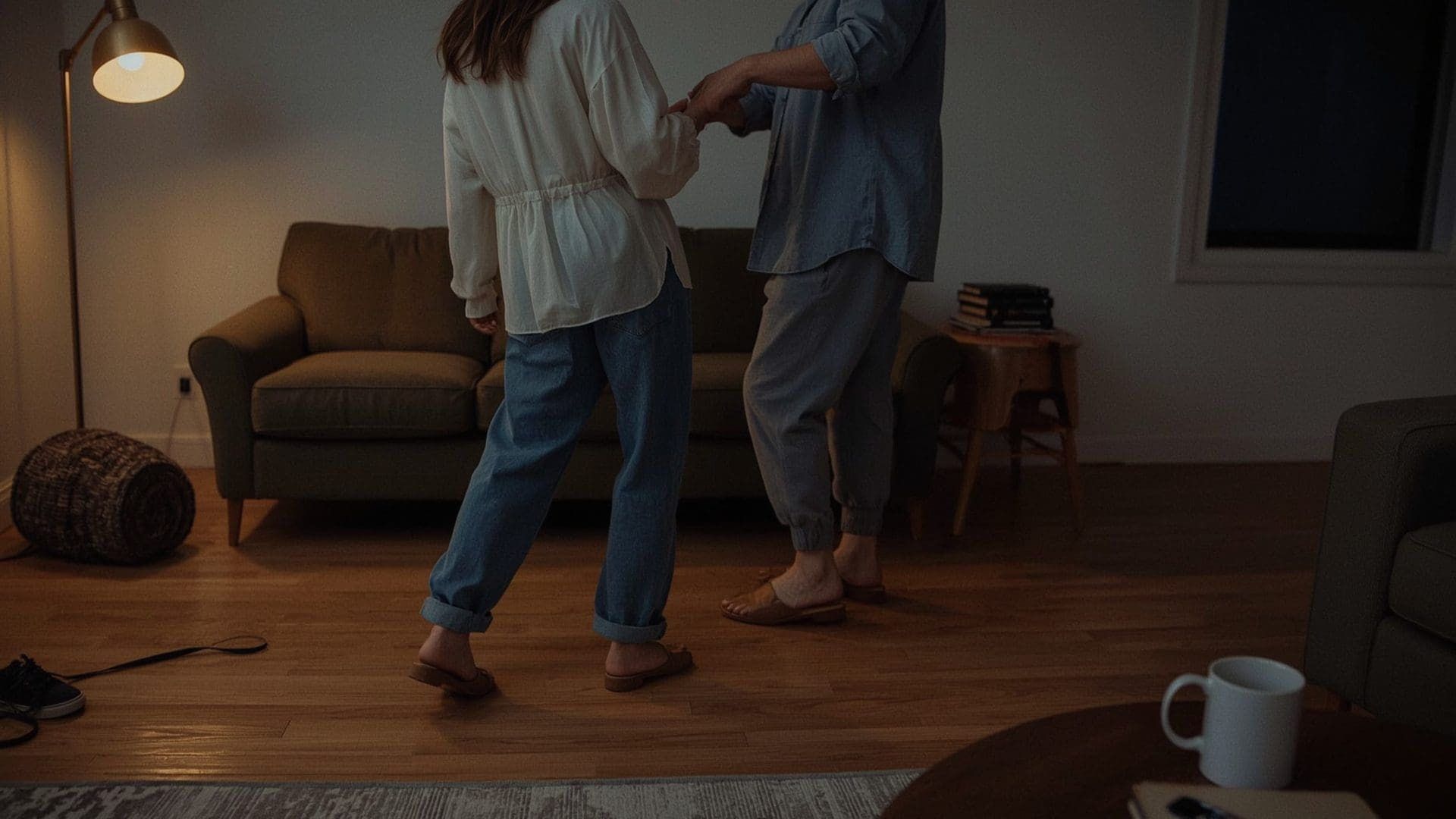
Quick Answer: Practice at home at least 3 to 4 times per week in the weeks leading up to the wedding. Use your exact edited song every time. Practice in your wedding shoes at least 4 to 6 times before the event. Clear a space roughly 8 by 8 feet — similar to the space you’ll have on the floor.
Effective Home Practice Habits
- Use a mirror or video: Recording yourself on a phone is the fastest way to spot issues your instructor hasn’t flagged. You’ll notice posture, timing, and eye contact problems immediately.
- Practice the hard parts separately: Don’t always run the routine from start to finish. Isolate the sections that keep breaking down — usually transitions between movements and spin timing — and drill those alone.
- Practice with background noise: Ballrooms and reception halls are loud. Practice with music playing at the same volume you’d hear it through a PA system. Some couples practice with guests clapping along.
- Mental rehearsal counts: Walking through the choreography in your head — visualizing each move in sequence — is a legitimate practice technique used by professional performers. Do it the night before your wedding.
Dress Rehearsal Checklist
- Practice in your exact wedding shoes at least four times before the event
- If the dress has a train, practice with a long skirt or similar fabric at least twice
- Run the full routine in your wedding attire at least one full week before the wedding — not the night before
- Confirm your edited song file is loaded on the DJ’s system before the reception starts
- Ask your DJ to cue the song from the correct starting point before you walk to the floor
What Should You Tell Your DJ About Your First Dance?
Quick Answer: Give your DJ a finalized edited MP3, the exact start and end point, any mid-song transition cues, your preferred volume level, and whether you want them to fade the ending or let it play fully out. Do this at least two weeks before the wedding — not the day of.
Your DJ is your most important technical partner for the first dance. Even perfect choreography falls apart if the wrong audio plays, the song starts at the wrong point, or the volume is too low for guests to feel the energy.
First Dance Audio Briefing Checklist
- Share your edited song file via a file transfer link — not a streaming link
- Label the file clearly: “FIRST DANCE FINAL EDIT — DO NOT CHANGE”
- Note any transition cues with timestamp (example: “Style change at 1:42”)
- Specify whether the song ends with a natural fade, a cold stop, or a full out
- Confirm the DJ will not talk over the intro or outro of your song
- Request that the DJ watch for your final pose and wait two full seconds before transitioning to the next song
What Are Common Mistakes Couples Make With First Dance Choreography?
Quick Answer: The most common mistakes are starting lessons too late, choosing a song that doesn’t match the dance style, overcomplicating choreography for the available rehearsal time, and skipping dress rehearsals in wedding attire. These are all avoidable with planning.
Mistake 1: Choosing the Wrong Song for the Style
Trying to waltz to a song in 4/4 time creates a rhythm mismatch that even non-dancers in the audience can sense. Always confirm the time signature and BPM of your song before committing to a style. Your instructor can help you check this in the first lesson.
Mistake 2: Overcomplicating the Routine
More moves are not better moves. A routine with 12 elements that you execute at 70% confidence looks worse than a routine with 5 elements executed cleanly. Let your instructor set the complexity level based on where you actually are — not where you hope to be.
Mistake 3: Not Practicing in Your Shoes
Heels change everything. A two-inch heel shifts your balance point, changes the length of your stride, and affects how you transfer weight through turns. If you learn choreography in flat shoes and perform it in heels for the first time on your wedding day, you’ll feel unstable at exactly the wrong moment.
Mistake 4: Waiting Until the Last Minute
Choreography needs time to move from conscious memory to muscle memory. That process takes weeks of repetition. Trying to compress 12 lessons into 3 weeks creates anxiety and over-reliance on mental recall — which breaks down under the pressure of performing in front of 150 guests.
Frequently Asked Questions About First Dance Choreography
Can we do first dance choreography if neither of us has ever danced before?
Yes. Most wedding dance instructors work primarily with complete beginners. A skilled instructor builds the choreography around your current ability, not an assumed skill level. Give yourself 10 to 14 lessons and start at least 4 months before the wedding.
How long should a choreographed first dance be?
Two to two-and-a-half minutes is the ideal length. Shorter than 90 seconds feels rushed. Longer than 3 minutes tests guest attention. Trim your song to fit this window and build your choreography around the edited version.
Do we have to do a formal dance style like ballroom?
Not at all. Contemporary and lyrical choreography is a popular alternative that doesn’t follow ballroom footwork patterns. It prioritizes emotional expression and movement quality over technical style rules. Many couples find it feels more natural and personal.
What if one of us is a much stronger dancer than the other?
Good choreography accounts for this. A skilled instructor will design the leading partner’s role to carry more visual complexity while the following partner’s movements remain clean and achievable. The audience sees a unified performance — not two separate skill levels.
Is online first dance choreography instruction effective?
Online instruction via video call can work for couples in areas without accessible wedding dance studios. It’s less effective for beginners who need hands-on correction of posture, frame, and weight transfer. Hybrid instruction — a few in-person sessions plus online support — is a practical middle ground.
Should we tell guests we rehearsed, or keep it a surprise?
Keeping the choreography a surprise amplifies its impact. When guests think you’re naturally dancing together and then a spin sequence or dip lands perfectly, the reaction is louder and more genuine. If you include a surprise song transition, definitely don’t mention it in advance — let the moment hit.